How to Choose Restaurant POS Software in Dhaka
Dhaka is one of the most competitive restaurant markets in South Asia. With thousands of restaurants packed into neighborhoods like Gulshan, Banani, Dhanmondi, Uttara, and Mirpur, standing out requires more than great food — it demands operational excellence. The right POS software is a critical piece of that puzzle.
This guide is specifically for Dhaka restaurant owners. Not generic advice from international blogs, but practical guidance based on the realities of running a restaurant in this city.
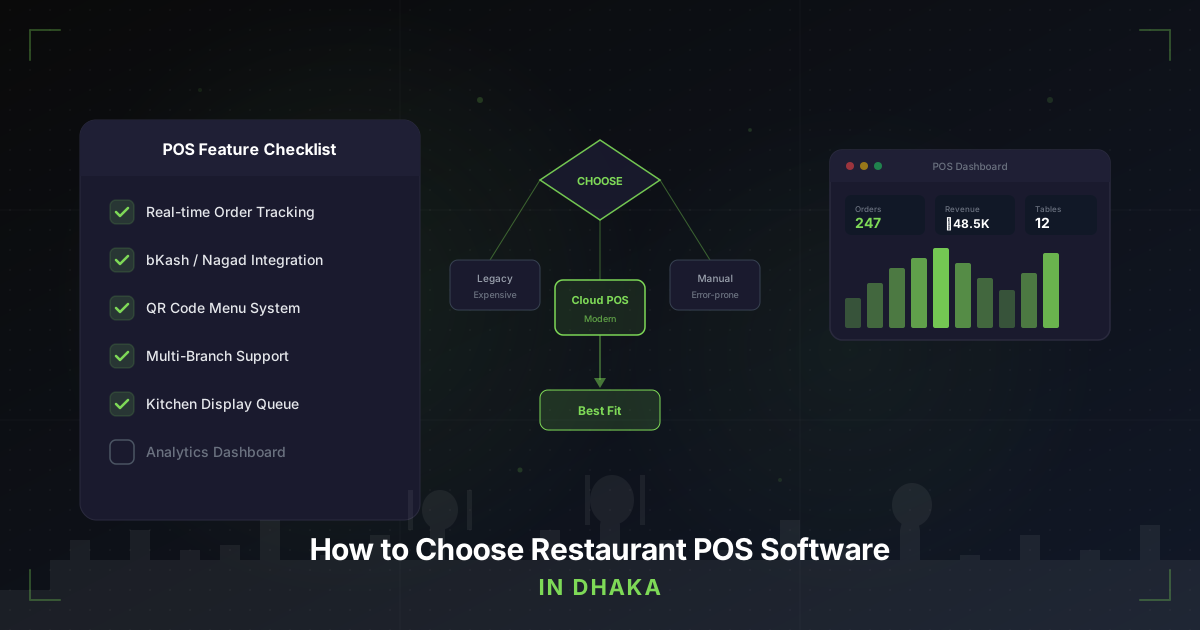
The Dhaka Restaurant Checklist
Before you evaluate any POS software, run through this checklist of must-have features for Dhaka restaurants:
### bKash and Nagad Integration
This is non-negotiable. Your POS must process bKash and Nagad payments seamlessly — ideally integrated into the ordering flow so customers can pay directly from their phones. Manual QR code scanning at the counter is acceptable but not ideal. True integration means the payment is linked to the specific order in your system, making reconciliation automatic.
### Offline Capability
Dhaka experiences frequent power outages and internet disruptions, even in commercial areas. Your POS must handle this gracefully. The minimum acceptable behavior: the system continues to take and display orders locally, stores all data, and syncs automatically when connectivity returns. No data should ever be lost.
Test this during your demo. Disconnect the WiFi and try placing five orders. If the system fails, it will fail during your busiest Friday night.
### Cloud Access for Owners
As a restaurant owner, you need to check sales, review reports, and monitor operations from anywhere — whether you are at your second branch, at home, or traveling. Cloud-based POS systems let you do this from any phone or laptop. If the system only works on a specific computer at the restaurant, you are tied to that location.
### Speed During Peak Hours
Dhaka lunch rushes between 1 PM and 2:30 PM are brutal. Your POS must handle rapid-fire order entry without lag. Test the system during simulated peak conditions — enter 20 orders in quick succession and see if it slows down. A one-second delay per order costs you real money when multiplied across hundreds of daily orders.
### Bangla Interface
Your cashiers and kitchen staff need to work fast and accurately. If they are struggling with English menu names or interface labels, errors increase and speed drops. A POS with Bangla language options — even if just for the kitchen display — makes a measurable difference.
Cloud vs. On-Premise for Dhaka
Cloud-Based (Recommended): Your data lives on secure servers. Access from anywhere. Automatic backups. Updates happen automatically. Monthly subscription model. Works on any device with a browser. If your local device breaks, you log in from another one and keep going.
On-Premise: Software installed on a specific computer at the restaurant. Your data lives on that machine. If the hard drive fails, your data is gone unless you have manual backups. No remote access. Lower monthly cost but higher risk and less flexibility.
For Dhaka restaurants, cloud-based is almost always the better choice. The flexibility and security outweigh the slightly higher monthly cost.
Staff Training and Adoption
The most common reason POS implementations fail is not technology — it is people. Your staff need to be comfortable with the system before you go live.
Train in stages: Start with basic order entry. Once that is smooth, introduce kitchen display features. Then add payment processing and reporting.
Assign a champion: Pick one tech-comfortable staff member to become the in-house expert. They handle day-to-day questions so you do not need to call support for every small issue.
Practice with real scenarios: Do not just show how the system works — run through actual service scenarios. A table of four ordering, modifying an order, splitting a bill, handling a bKash payment that fails and needs to be retried.
Common Mistakes Dhaka Restaurant Owners Make
Choosing the cheapest option: A ৳1,000/month POS that crashes during peak hours or lacks bKash integration costs you far more in lost revenue and frustrated customers than a ৳5,000/month system that works reliably.
Ignoring support quality: When your POS has an issue at 8 PM on a Saturday, you need responsive support. Ask vendors about their support hours, response times, and whether they offer phone support in Bangla. Email-only support with 24-hour response times is not acceptable for a restaurant.
Not testing with real orders: Demo environments with five sample menu items do not reveal real-world problems. Load your full menu — all 80+ items with modifiers and variants — and simulate a busy service period.
Skipping the trial period: Any vendor confident in their product offers a free trial. If a vendor insists on a long-term contract without a trial, that is a red flag.
Questions to Ask Every Vendor
Why Restoio Works for Dhaka Restaurants
Restoio was built with Dhaka's specific challenges in mind — offline-first architecture that handles load shedding, native bKash and Nagad integration, cloud-based access from any device, and local support from a team that understands the Bangladeshi restaurant industry. It is worth requesting a demo to see how it handles your specific workflow.
Take the Next Step
Start with a clear list of your requirements. Request demos from two or three providers. Test each one with your real menu and your actual staff. The right POS software will not just process orders — it will make your entire operation faster, more accurate, and more profitable.